Seven real projects on Wellbore.AI—correlation, ML log reconstruction, lithofacies, end-to-end audit, NMR inversion, joint NMR + imager interpretation and capillary modelling. Numbers, methods and what changed for the team.
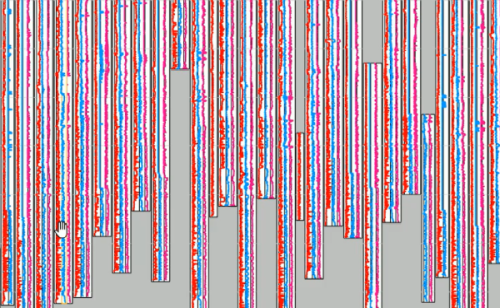
An operator needed a single vetted correlation across the entire well stock for 15+ reservoirs. Two senior geologists were spending two weeks per region, working in separate project files with no real-time visibility into each other. Navigating 300+ wells was painful because of GPU lag.
All wells loaded into a single Wellbore.AI project. Both geologists worked in parallel on the same live canvas, seeing each other's picks update in real time. GPU rendering of 300+ wells stayed smooth across pan, zoom and depth-shift operations. Every pick was versioned for audit.
The full correlation across 312 wells and 15+ reservoirs was delivered in two working days—roughly 7× faster than the previous region-by-region approach. Two geologists completed what used to need a team of six.
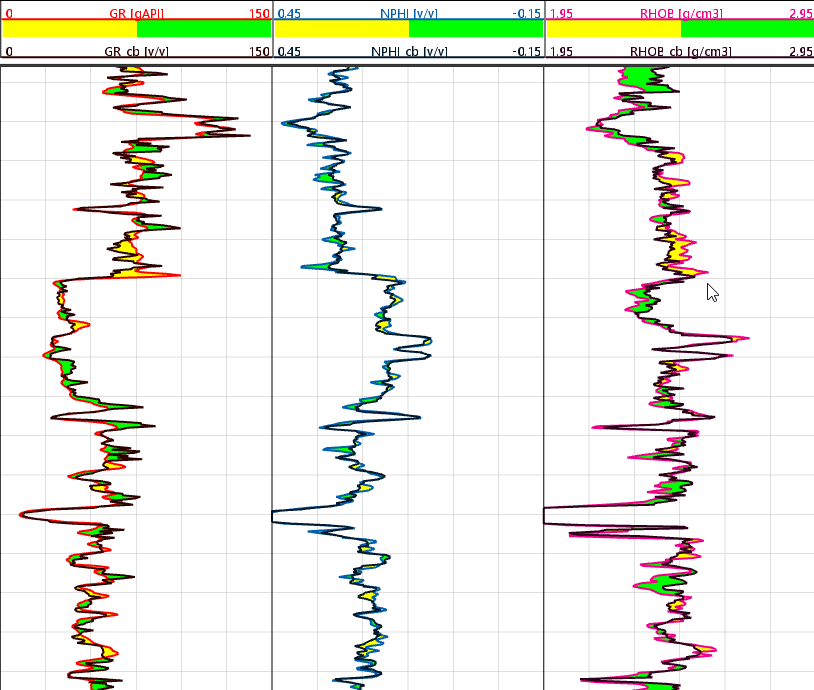
1,200 wells were missing the density log (RHOB)—only gamma, resistivity, SP and neutron from a mix of vintage tools were available. RHOB was the basis for the porosity model, and manual reconstruction would have taken a small team several months.
An ML model was deployed directly inside Wellbore.AI and launched as a regular workflow step—no external pipeline, no data export. The model was trained on the small subset of wells with a complete logging suite, then applied across all 1,200 wells in a single run.
1,200 wells processed end-to-end. R²=0.87 against held-out test wells. About 90% of the manual work was eliminated, and a field-wide porosity model was available the same day instead of the next quarter.
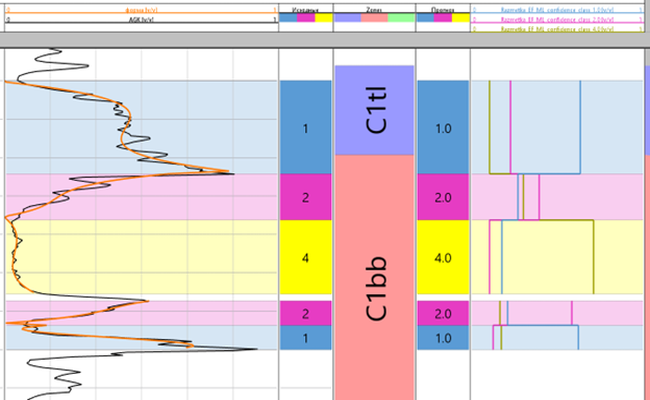
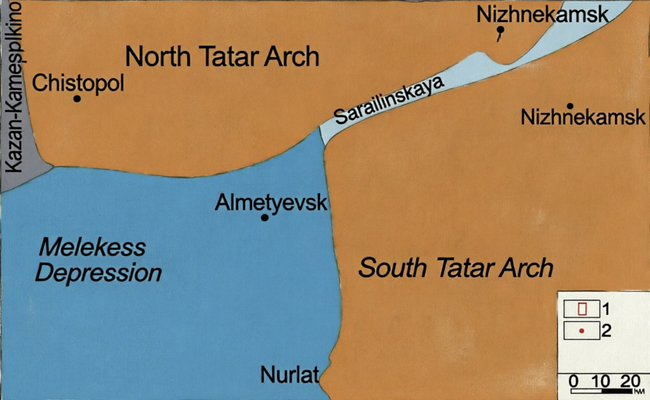
A regional sedimentology study needed consistent lithofacies predictions across three clastic reservoirs. Manual picking was slow, inconsistent between interpreters, and couldn't scale to the full well set—every additional well meant another week of work.
Each log was rasterised into a multi-channel curve image and fed to a vision backbone fine-tuned on petrophysical morphology — the same family of architectures used in medical imaging and document analysis. The model learned shape-aware embeddings directly from curve texture, not just amplitudes, so subtle facies boundaries became visible in the embedding space. Core descriptions were used only to label and validate the resulting clusters, not to hand-engineer features.
40 wells processed automatically in a single day. Less than 12% of expert edits were needed to reconcile with core. Silhouette score above 0.5 confirmed clean cluster separation, and the speed-up over manual picking was on the order of 1,000×.
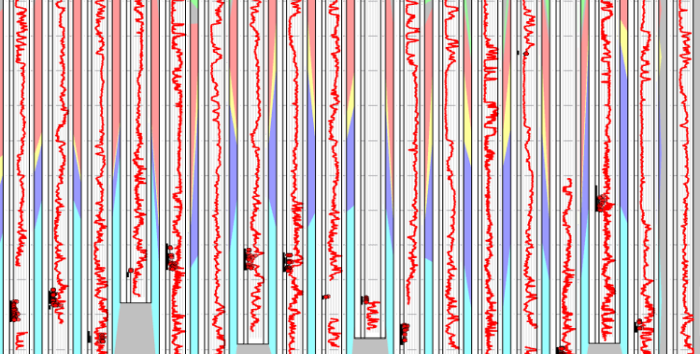
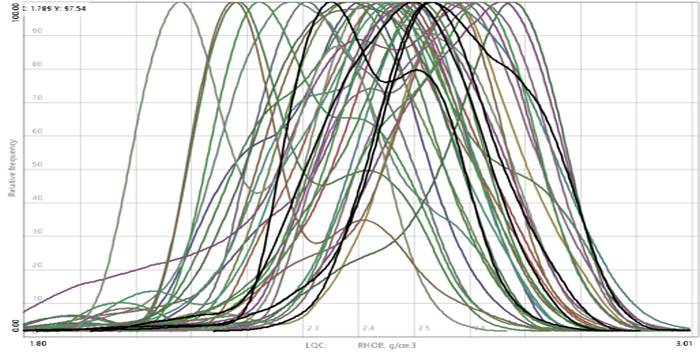
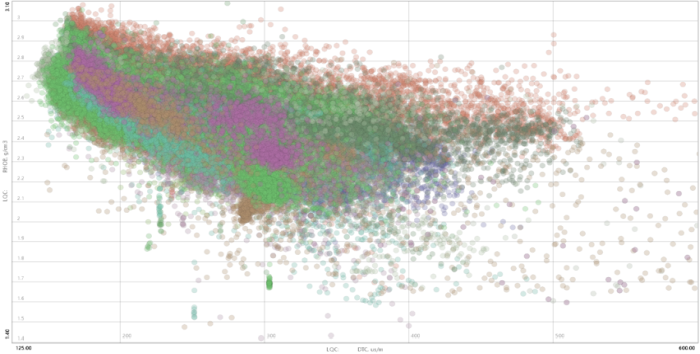
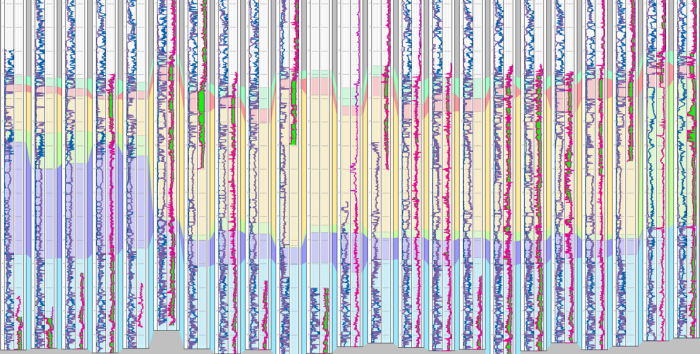
A field with more than 1,400 wells needed end-to-end audit and re-interpretation: legacy LAS files from multiple vendors, mixed clastic and carbonate sections, scattered stratigraphy, plus existing core and inclination data. The operator wanted H_eff and prospectivity maps for six reservoirs inside one week.
One Wellbore.AI project ran a fully automated processing graph: data audit, recomputation of gamma and neutron logs, sonic—density cross-validation, a mineralogical model, ML-based density reconstruction trained on 35 cored wells, and the final interpretation including missed-pay flags. Prospectivity maps for all six reservoirs were generated inside the same project.
1,400+ wells in a single project. From raw LAS to drilled-ready recommendations in four working days. Six reservoir prospectivity maps delivered, and several previously missed pay zones flagged for re-perforation and follow-up testing.
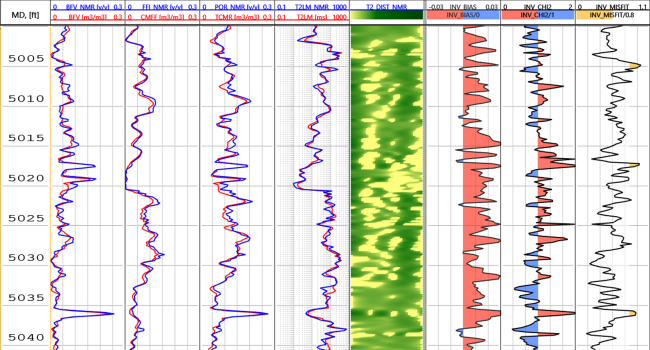
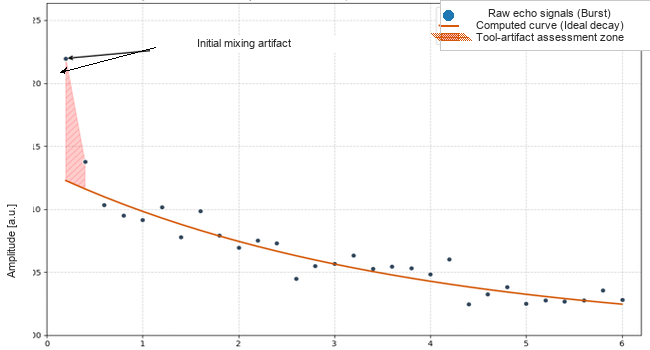
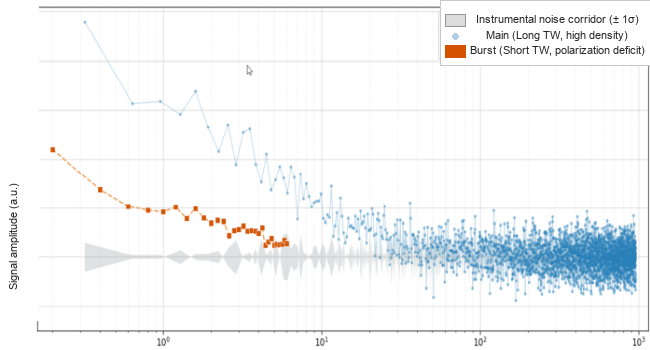
A carbonate field had NMR data acquired with two pulse sequences (Main and Burst). The Burst sequence was producing spurious T2 peaks and unstable porosity because of low SNR. Standard single-sequence inversion was not delivering usable results, and the interpreter could not trust the porosity log.
A physics-aware preprocessing step—phase rotation plus statistical SNR weighting—was followed by a joint Fredholm-kernel inversion across both Main and Burst sequences simultaneously. The whole pipeline was implemented as a native Wellbore.AI node, so it could be re-run on every well in the field.
Both sequences inverted together, with zero false T2 peaks in the resulting spectrum. Porosity logs were stable and repeatable across the carbonate section, and the workflow now runs unattended on every new well added to the project.
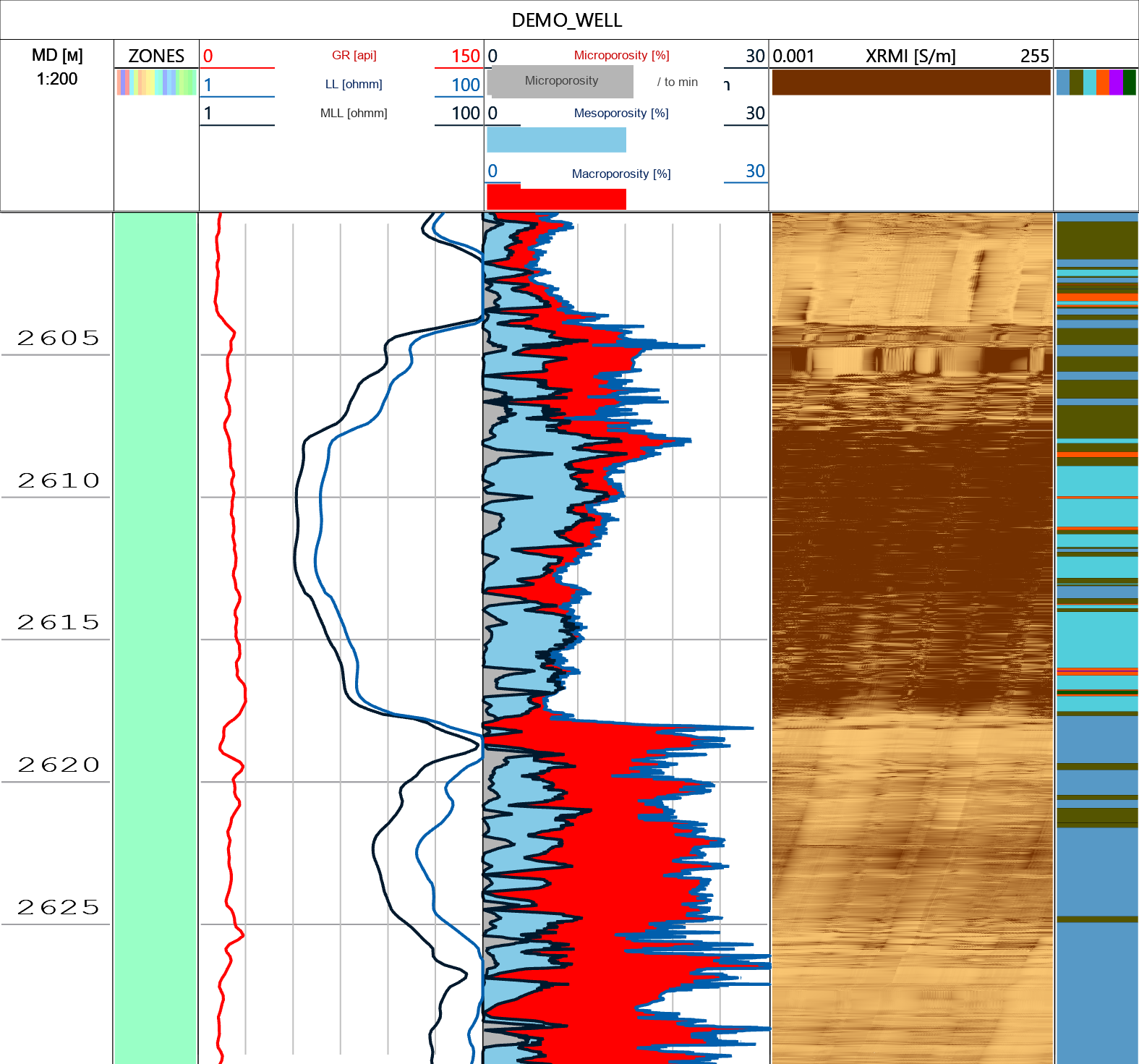
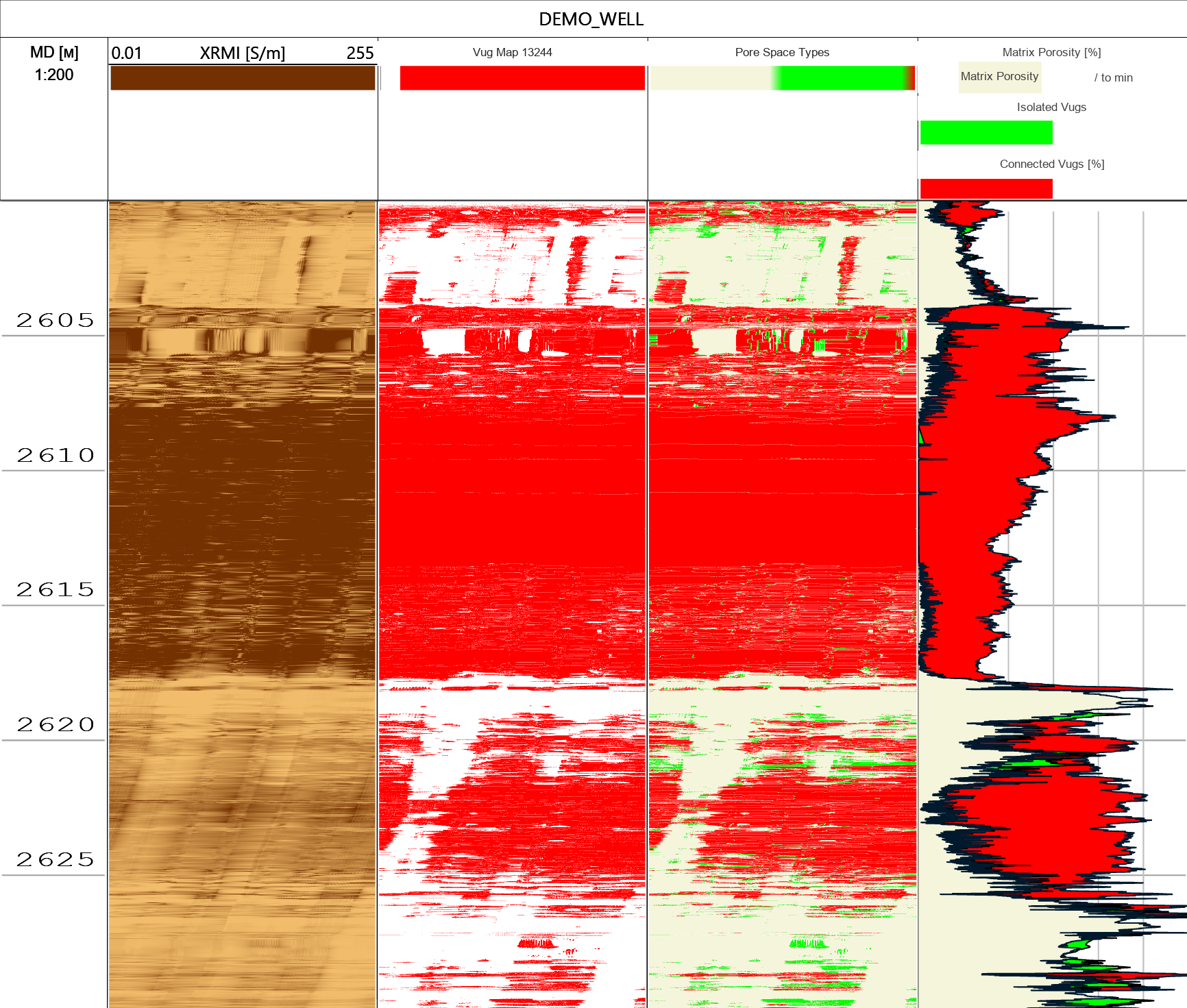
A heavily heterogeneous carbonate reservoir with vuggy intervals scattered through the matrix. A single cementation exponent m=2.0 systematically miscalculated water saturation in cavernous zones, and conventional NMR processing lumped micro-, meso- and macro-porosity into a single bulk number. Neither the storage hierarchy nor the flow contribution of vugs was visible to the interpreter.
A joint interpretation pipeline built on Wellbore.AI: automatic vug segmentation on the electrical image log to isolate cavernous intervals, Gaussian decomposition of the NMR T2 spectrum into micro-, meso- and macro-porosity components, a variable cementation exponent m(z) driven by the Ramakrishnan—Bruggeman model, and a hybrid SDR + macro-porosity permeability that combines matrix flow with vug flow.
Three porosity fractions separated per depth sample — micro, meso and macro — replacing the single bulk-porosity number that was hiding the storage hierarchy. Seven lithology classes with a variable m(z) per class instead of a single m=2.0. A hybrid SDR + macro permeability model that captures both matrix flow and vug flow, which neither Archie's law nor a single-NMR model can deliver on their own.
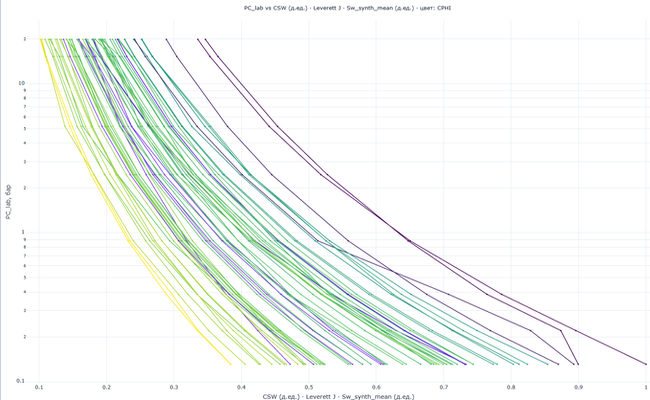
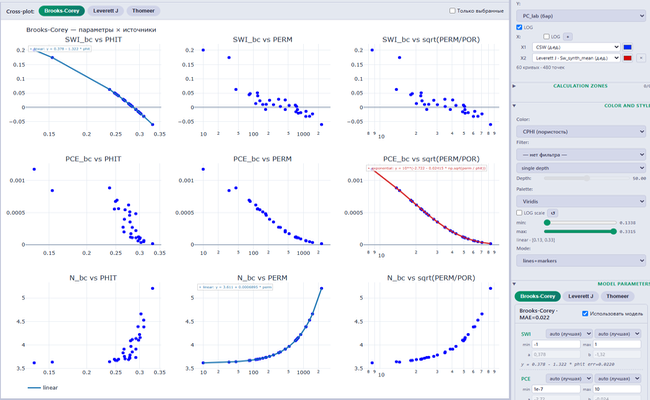
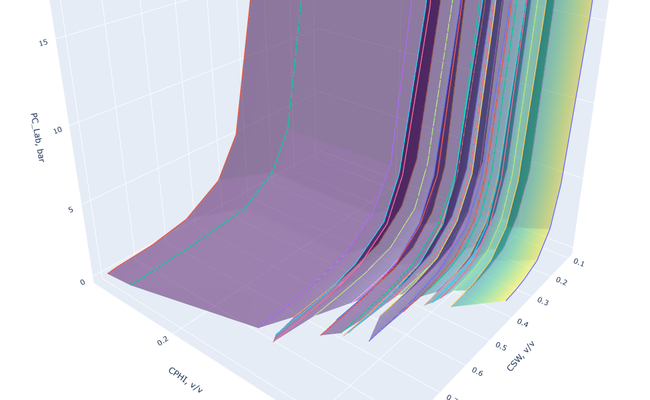
A polymictic clastic reservoir with quartz, feldspars and rock fragments, variable clay cement, and permeability swings from 1 to 400 mD across short depth intervals. A single Brooks-Corey Pc(Sw) curve fitted to all capillary pressure data at once could not describe the spread, and manual fitting took 2—3 months with different answers from different interpreters.
A new adaptive fitting tool inside Wellbore.AI: an adaptive Pc(Sw) model with automatic lithotype splitting and a per-lithotype Brooks-Corey fit (Pc_entry, θ — contact angle) against capillary pressure data, including parameter uncertainty estimation. The interpreter only had to mark the lithotype boundaries; the algorithm did the rest.
R²=0.92 for the Pc(Sw) fit when applied per lithotype. Three lithotypes calibrated from 25 capillary pressure samples, with quantified uncertainty on Pc_entry and θ. The workflow ran about 12× faster than the previous manual approach. Screenshots are shown on a synthetic Wellbore.AI test project; operator data is under NDA and not approved for publication.